Description
A fish of rivers with current and a gravel bottom.
How to identify it
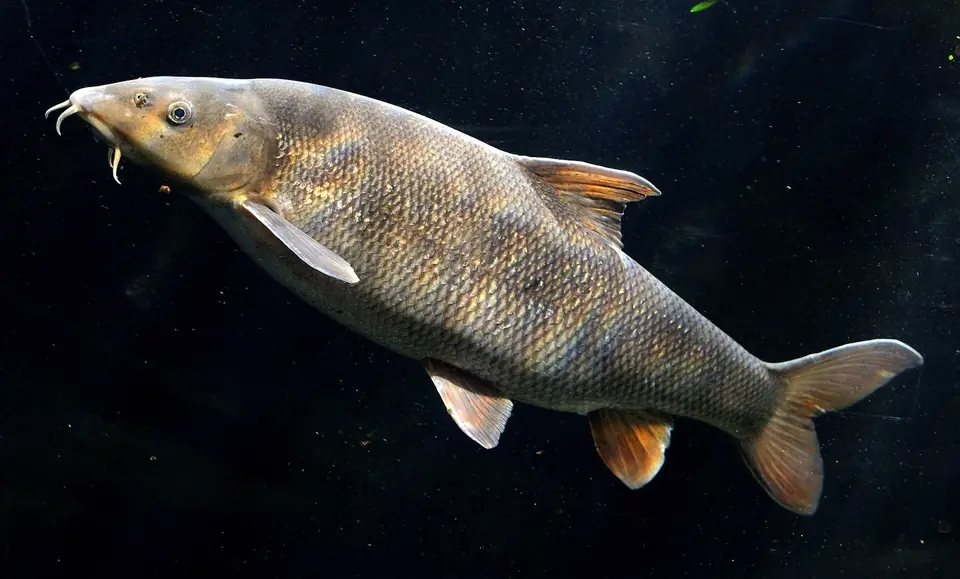
Four barbels, inferior mouth with fleshy lips, serrated ray in the dorsal.
Appearance
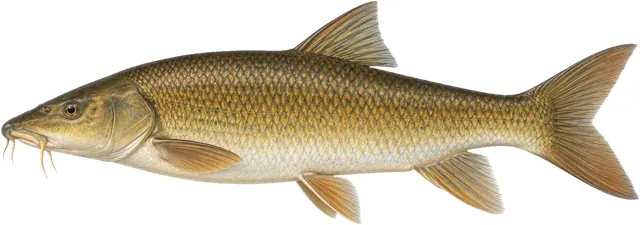
Long, tapered body, with a flat belly, sloping forehead and pectoral fins held horizontally: a shape designed to stay glued to the bottom even in strong current. Adults are dark brown, bronze or grey with a pale belly and fins tinged red or orange, while the young are grey and marbled. The tail has unequal lobes: the lower one is shorter and rounded, the upper one pointed. The barbels and the downward-facing mouth set it apart at once from chub and id.
Habitat and habits
It is the typical fish of rivers with fast current and a gravel or stony bottom, so much so that it gives its name to the barbel zone. It is also found in slower rivers and, if stocked, in still waters. It lives near the bottom, often in shoals, and makes use of deep pools, sunken branches, undercut banks and snags. It feeds mainly at night; by day it feeds in the deeper water or in the shelter of snags. It moves a lot along the river and in spring runs upstream to the gravel where it spawns.
Related species and forms
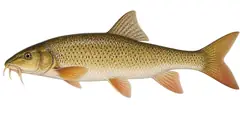
Large-spot Barbel
Barbus balcanicus
Small stream barbel of the Barbus petenyi group, in German Semling (also Hundsbarbe).
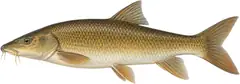
Italian barbel
Barbus plebejus
Barbel native to northern Italy (Po barbel or Italian barbel), a bottom-dwelling fish of clear rivers with lively current, much appreciated by anglers for its fighting spirit.
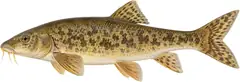
Mediterranean barbel
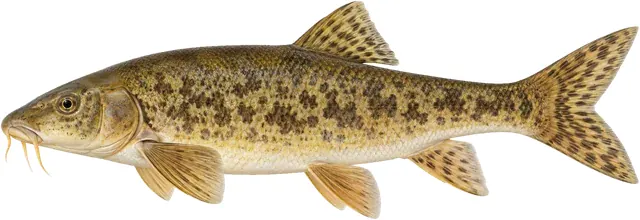
Barbus meridionalis
Small bottom-dwelling barbel of the middle and upper reaches of Mediterranean rivers of south-western Europe, described by Risso in 1827 (in Italian 'barbo meridionale').

There's more in the app
This species' bite index, recommended baits and methods, and the rules of the day for every water. Offline too.
Out on Android and iPhone